
I Thought That Wasn’t Halal
Issue 1 | December 2025
In this first issue, we share what we worked on in 2025, key insights from our Halal study, how our work is already being used by advocates, and what’s ahead!
Welcome from the founders!
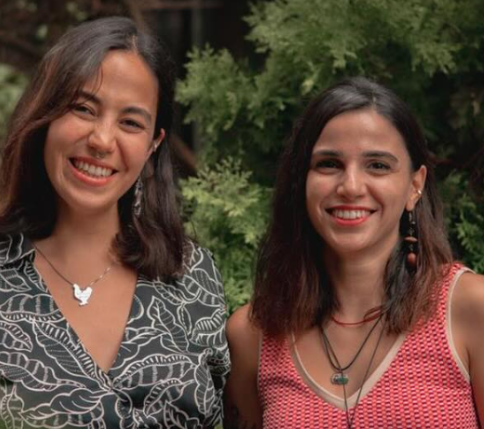
Hello friends — and welcome to our very first newsletter!
We’re Gülbike & Sueda, co-founders of Animetrics. It’s been a little over 2 years since we began applying economic and evidence-based research tools to help advocates, policymakers, and communities across the Global South and Muslim world.
A huge thank you to everyone who has supported us and believed in our work. And if you’re new to Animetrics – welcome! Our plan is to share updates roughly per quarter — highlights, stories, and new lessons from our work as it grows.
This year, our attention centered on two things: (1) Producing rigorous, locally grounded evidence in neglected regions, and (2) Turning that evidence into tools advocates can actually use.
In 2025, we:
Finalized one high-quality, policy-relevant paper from Türkiye
Launched our new Implementation Support program
Delivered 8 capacity building projects to support advocates
Advanced 2 multi-country projects across MENA and Muslim-majority regions
Presented at 3 conferences & received the PHAIR Best Poster Award
Shout-out to our donors & supporters!
We’re very grateful for the trust and support we received this year from our community. Special thanks to Craigslist Foundation, Food System Research Fund, Phauna Foundation, Animal Charity Evaluators, Stray Dog Institute, the William & Charlotte Parks Foundation, VegTrust, and LUSH along with the many individual supporters who make our work possible. Your support helps us build a research program that is rigorous, context-sensitive, and designed for real-world impact.
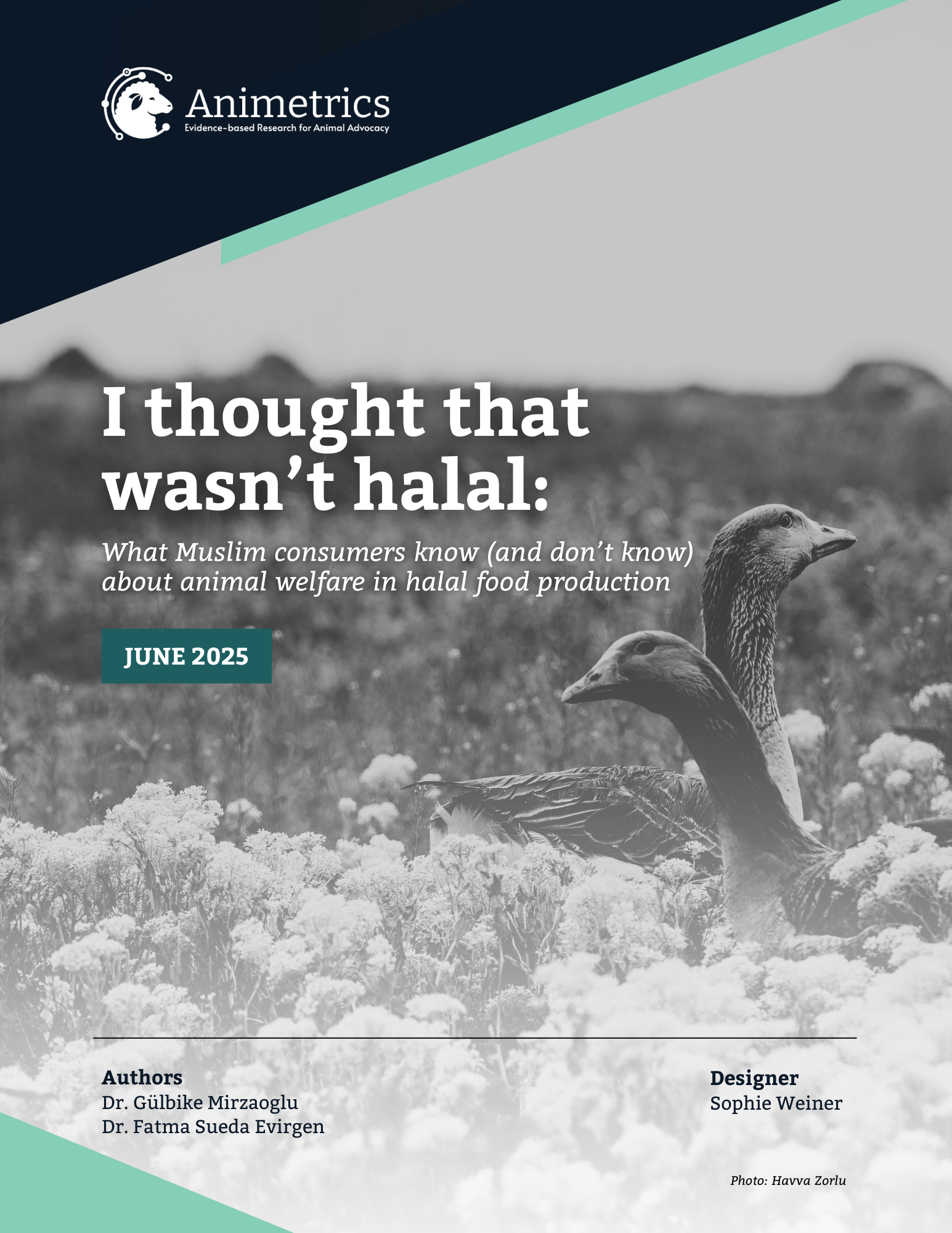
Featured study —“I Thought That Was Halal!”
Muslims make up nearly one-quarter of the world’s population, and that number is rising fast. Yet despite its scale, the halal food sector remains one of the most understudied areas in farmed animal advocacy.
Muslim consumers often associate halal with compassion and ethical treatment. But what happens when they find out some practices fall short of their expectations?
To explore this question, Animetrics conducted a first-of-its-kind study with 788 Muslim adults in Türkiye.
What we found
Knowledge gaps were huge. 57% to 80% of respondents did not know that certain harmful practices are allowed in halal production.
The biggest gaps? Chick culling and the lack of long-term medical care.
Accurate information changed intentions.
Many said they would buy fewer products tied to these practices.
💡 Key Insight: People who held incorrect beliefs (vs. who “did not know”) were more likely to change their intentions.
Why this matters
Halal is a multibillion-dollar global industry serving nearly a quarter of the world’s population. We know very little about halal consumers — especially their beliefs and expectations around animal welfare.
Our study revealed a clear gap between what people expect from halal and what is currently allowed — and that gap creates a real opportunity for positive change.
When people learn that certain practices don’t match what they thought halal stood for, many rethink their choices. And when people make different choices, we have a chance to reduce animal suffering on a large scale.
Read the study summary or download a 1 page poster to learn more.
Ongoing research projects
Attitudes towards farmed animals in Middle East
(with Middle East Vegan Society + Sezin Ekici — underway)
First multi-country effort to map public views on animal agriculture in the Middle East: United Arab Emirates, Kuwait, Lebanon, Qatar, and Saudi Arabia.
Why it matters:
Regulation and advocacy are shaped by public opinion, yet most research comes from the West.
MENA populations are large and growing.
What works in the West may not translate to other regions. Inclusion of MENA perspectives essential for effective, locally relevant policy and advocacy.
Muslim perspectives on animal welfare & Halal food systems
(with Kaleem Ahmid — underway)
A 15-country study building the largest open dataset and first research of its kind to support culturally grounded effective advocacy.
What we’re asking:
How do Muslims across the world understand farmed animal welfare?
How do religious values, halal food, and cultural norms shape views on meat consumption and animal treatment?
Advocay support updates
Introducing our new implementation program
The movement is producing more research than ever, and that’s a strength. But ensuring this knowledge is accessible, relevant, and usable across diverse contexts requires intentional support. We are designing our new program as a framework (planned for public release in Q1 2026) to help make it easier for advocates and organizations to apply evidence in ways that fit their goals and realities.
The framework centers on:
🔹 Co-developing research and its outputs with advocates
🔹 Sharing findings in clear and practical formats
🔹 Learning from how evidence is used, so we can improve together
Capacity strengthening
For us, capacity building means working alongside our partners to reduce the barriers they face in doing evidence-informed advocacy. We support them in designing surveys, conducting impact evaluations, trainings, interpreting findings, and more.
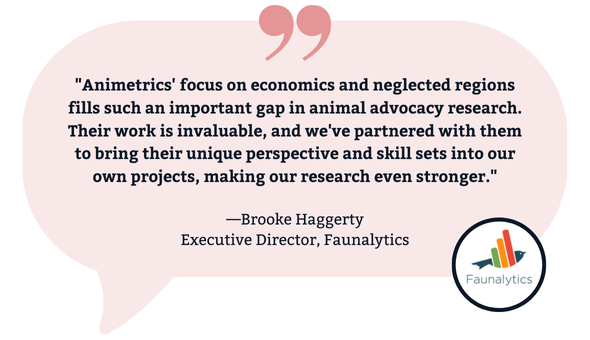
Since founding, we’ve delivered 21 capacity-building projects to organizations like Faunalytics, Plant Based Treaty, Gulay Pa More (Philippines), Podrska Foundation (Uganda), and more.
What partners tell us:
4.9/5 average quality rating
90% reported time saved
80% reported resource savings
Impact
Impact can mean different things across the advocacy ecosystem, and research contributes through a more indirect pathway: by informing the decisions, priorities, and approaches of others.
This means our influence shows up when advocates, policymakers, and institutions integrate our evidence into their work.
How is our research used?
1️⃣ Evaluating Consumer Confusion
Cited by Rethink Priorities, added to Faunalytics’ library, and GFI’s research databases
Directly used by Fundación Veg (Chile) in drafting amendments to a restrictive FoodTech bill currently under legislative review.
Currently working with a leading Turkish plant-based association: they’ll be using our findings to push for transparent labeling in talks with ministries and consumer education, and Animetrics will support their evidence-based case.
2️⃣ I Thought That Wasn’t Halal!
Shared by various advocacy groups for consumer education
Organizations indicated that they’ll be using the findings for campaigns, talks with halal certification bodies, and as inputs for their own surveys
Early users (the advocates, campaigners, and partners who responded to our feedback survey) describe the report as both informative and immediately actionable.
3️⃣ Attitudes Towards Farmed Animals in the Middle East (coming soon!)
The study was co-developed with the Middle East Vegan Society to directly address their practical needs. We’ll work 1-1 with them to help them understand the results and apply them in practice for their strategy.
"Working with Animetrics will help us shape our strategy as an organization concentrating in a neglected area of the world with very little information or experience on animal rights or welfare advocacy." —Middle East Vegan Society
Sharing our work
Conferences. To date, we have presented our work at 10 international conferences, helping bring regional and culturally grounded evidence into global advocacy spaces.
Podcasts & Media. Our work continues to reach new audiences through podcasts and media outlets, including:
Podcast- “Cheese is forbidden, oppression is accepted” (HAKIM)
Interview- PHAIR Society
Interview- WZB Berlin Social Science Center blog (to be published here this month!)
Looking ahead
What’s coming in 2026? We’ll release 2 open datasets, 7 research studies, shape and scale our Implementation Support, and deepen partnerships.
Where we’ll be? AVA Argentina (Gülbike), AVA Canada (Gülbike and Sueda), AVA Academy Berlin (Sueda), EA Nordics 2026 (Heather).
Support & connect
Want to use our research in your work? Let us know!
Share feedback on our implementation plan, what you’d like to see in future issues, or anything else. Tell us!
Support our work by donating.
Send us books, articles, or ideas we should be reading!
Introduce us to funders and foundations supporting Global South or Muslim-community work.
Follow us on LinkedIn, Instagram, and learn more on our website.
With gratitude,
Gülbike Mirzaoğlu, PhD - gulbike@animetrics.org
Fatma Sueda Evirgen, PhD - sueda@animetrics.org
